Wake Windows vs. Sleepy Cues: What Should You Actually Follow?
The age-old Instagram debate.
Should you follow your child's lead and put them to sleep when they show sleepy cues (wouldn't life be easier if they could just say it)? Or should you follow wake windows to avoid overtiredness — the fear of all parents everywhere?
The short answer? It's a bit of both.
What are sleepy cues in babies?
Sleepy cues are the ways your baby shows you they're getting tired. Common sleepy cues include:
Glazed-over stare
Rubbing eyes
Red eyebrows
Yawning
Fussiness
Losing interest in play
These cues can be incredibly helpful, especially in the newborn stage. But as babies get older, things get a little more complicated.
Why sleepy cues aren't always reliable after 4 months
As babies get older, sleepy cues can sometimes mean things other than sleep. Have you ever yawned during a really boring meeting at work and had to force your eyes open even though it was nowhere near bedtime? Same idea.
Around 4 months and older, babies need much more stimulation during awake time. One random yawn an hour into the wake window doesn't always mean "rush them to bed immediately."
Sometimes they're:
Bored
Understimulated
Needing a change of scenery
What are wake windows?
Wake windows are the amount of time your baby can comfortably stay awake between sleeps.
As babies grow, they need more time awake in order to build enough sleep pressure for a good nap or bedtime. Sleep pressure is essentially the body's drive for sleep. As we use energy throughout the day, adenosine builds up in the brain and contributes to sleepiness. At night, that sleep pressure works together with melatonin and the circadian rhythm to help us fall and stay asleep. So yes, there really is science behind why your baby can't just nap every 45 minutes forever.
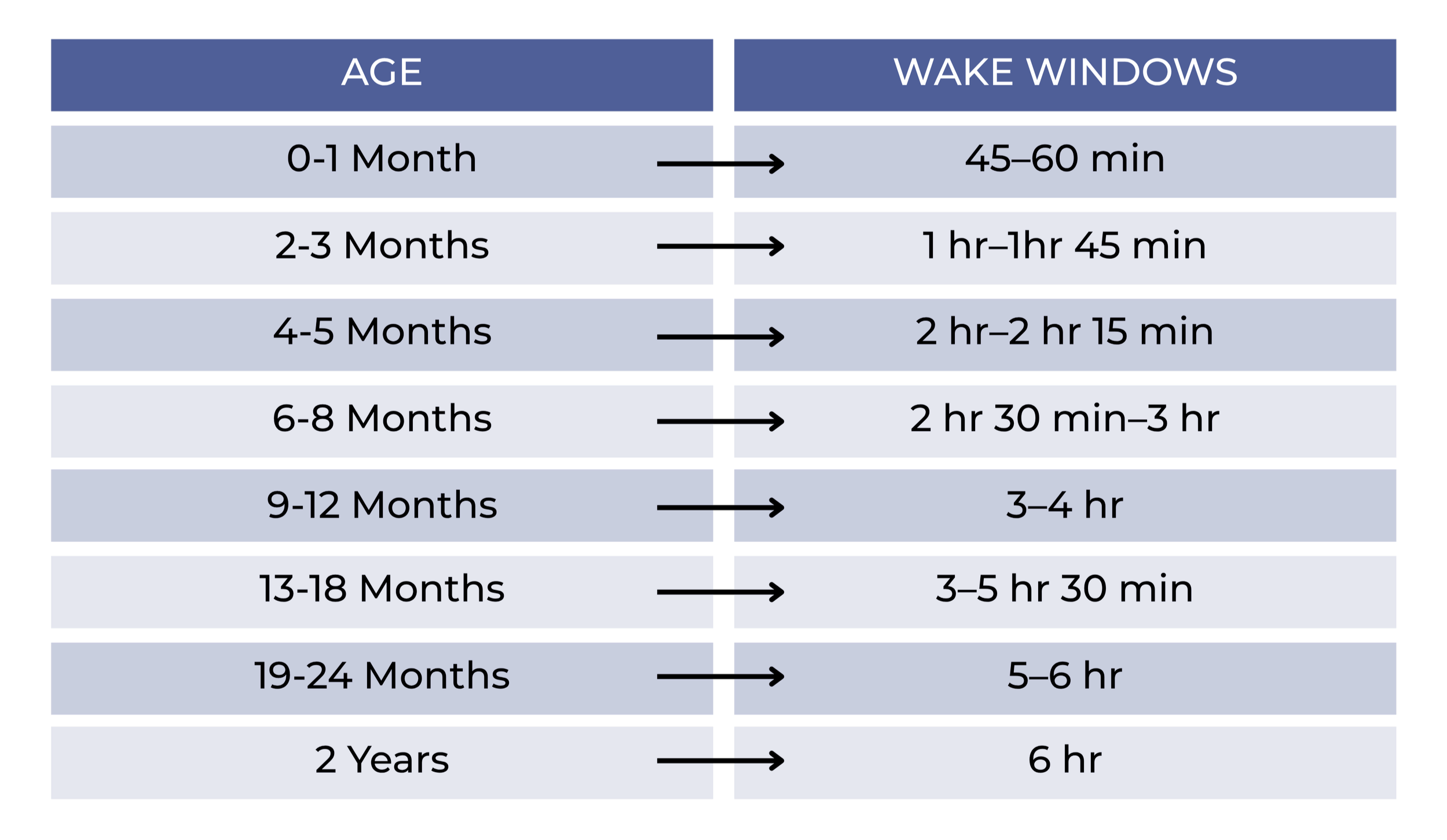
Wake Window Chart - Have Baby. Must Sleep.
Why wake windows are ranges, not rules
If you've ever Googled wake windows, you've probably noticed every source says something slightly different. That's because every baby is different.
Some babies are more active, more sensitive to stimulation, or have higher or lower sleep needs overall. A baby who has spent the entire wake window swimming, doing tummy time, and exploring a new play space may be exhausted earlier than expected. Another baby may need more time awake to build enough sleep pressure for a solid nap.
Wake windows are a guide. A starting point. Not a countdown clock to disaster.
How to combine wake windows and sleepy cues
If you've had a very busy wake window and your baby is yawning, rubbing their eyes, and getting fussy 15 minutes before the wake window ends? Absolutely put them down. This is exactly where combining wake windows and sleepy cues becomes really helpful.
Step 1: Look at your baby's age and their general wake window range.
Step 2: As you approach the end of the wake window, start monitoring for sleepy cues.
Step 3: When you notice multiple sleepy cues and/or you're nearing the end of the wake window, start the nap routine. One eye rub or one yawn alone doesn't usually mean your baby urgently needs sleep.
That's it. We don't need perfection here.
Wake windows are not a countdown to disaster
In a perfect world, you notice every sleepy cue and always know when the wake window is ending. In real life, sometimes you're busy, you miss the yawn, or you look at the clock and realize nap time snuck up on you. If your baby goes down 15 minutes late and gets a little overtired, the world will not end. Maybe it won't be their best nap. Maybe they'll need a bit more support settling. Maybe you adjust the timing next time. Or maybe nothing bad happens at all.
One rough sleep does not undo everything.
What does an overtired baby look like?
An overtired baby might:
Have a rigid or tense body
Be harder to settle
Become very fussy
Seem "wired" instead of sleepy
Fight sleep despite clearly needing it
And if you hit this stage, you have not done anything wrong. Overtiredness happens to all of us.
What to do when your baby is overtired
Step 1: Accept that it may take longer for them to fall asleep and try not to panic. Your stress tends to increase their stress.
Step 2: Offer comfort in whatever way aligns with your usual sleep approach.
Step 3: Be flexible. This might be the perfect time for a stroller nap or a car nap.
One off-plan nap or bedtime will not create a bad habit. When it comes to sleep, consistency over time matters far more than one difficult day.
The bottom line on wake windows and sleepy cues
Wake windows and sleepy cues are not meant to compete with each other. The goal is not to perfectly "time" your baby every single day. The goal is simply to understand your child a little better and respond accordingly.
Use wake windows as your guide. Use sleepy cues as confirmation. And remember that flexibility is part of parenting too.
If you've read this and still feel overwhelmed or unsure how to apply any of this to your child, reach out to us. We'll create a tailored plan based on your baby's specific needs and take the guesswork out of sleep.
Many of our services may be eligible for reimbursement through extended health benefits. Visit our Insurance & Benefits Coverage page to learn how coverage works and which programs may qualify, or book a free discovery call to find the best fit for your family.
Author: Eden Greenberg, RSW, MSW, Certified Pediatric Sleep Consultant
Eden Greenberg is a Registered Social Worker, Certified Pediatric Sleep Consultant, and mom of one. Her passion for sleep support began when she became a parent herself and experienced firsthand the impact that healthy sleep can have on a child's development and a family's overall well-being.
With a background in clinical social work, Eden brings a unique perspective to sleep support, recognizing that sleep is closely connected to mental health, emotional regulation, family dynamics, and parental confidence. She combines evidence-based sleep strategies with compassionate, individualized support to help families navigate everything from frequent night wakings and nap challenges to bedtime battles and sleep regressions.
Known for her warm, collaborative, and non-judgmental approach, Eden believes there is no one-size-fits-all solution to sleep. She works closely with families to develop realistic, sustainable plans that align with their parenting style, goals, and comfort level.
As both a sleep consultant and social worker with Have Baby. Must Sleep., Eden is passionate about helping families feel more rested, confident, and supported because when families sleep better, everything feels a little easier.
Ready to get your family sleeping? Book a call with Eden here.
About Have Baby. Must Sleep.
Have Baby. Must Sleep. is a pediatric sleep consultancy helping exhausted families navigate sleep from newborn through age five with confidence, compassion, and realistic support.
Founded by mom and sleep consultant Andria Gordon, the company was built on the belief that families deserve more than generic sleep advice and rigid one-size-fits-all methods. Today, the Have Baby. Must Sleep. team has helped thousands of families improve sleep through customized, relationship-focused support tailored to each child, parenting style, and family dynamic.
Known for its balanced and supportive approach, the team also offers benefits-covered programs that integrate pediatric sleep support with perinatal mental health care through registered social workers.
Learn more at www.havebabymustsleep.com.